How AI Is Changing HVAC System Performance
Artificial intelligence has become one of the most overused terms in HVAC marketing. Today, everything from basic scheduling to simple WiFi thermostats is labeled “AI-powered.”
In reality, true AI in HVAC systems is far more specific (and far more useful) than most people realize.
When applied correctly, it allows HVAC systems to predict demand, reduce wasted runtime, detect problems earlier, and improve performance in energy efficient HVAC systems and modern smart HVAC systems.
This article breaks down what AI in HVAC actually means, how it’s being used today, and where it delivers measurable results, without the buzzwords.
What “AI in HVAC” Actually Means
(AI vs. Automation vs. Smart Controls)
Before evaluating whether an HVAC system truly uses artificial intelligence, it’s important to separate three terms that are often used interchangeably, but mean very different things in practice.
Automation
Automation relies on fixed, rule-based logic. The system follows preprogrammed instructions and responds the same way every time a condition is met.
Example:
Changing temperature setpoints based on a daily schedule
Turning equipment on or off at predetermined times
Automation improves consistency, but it does not adapt or learn. It only does what it’s told.
Smart Controls
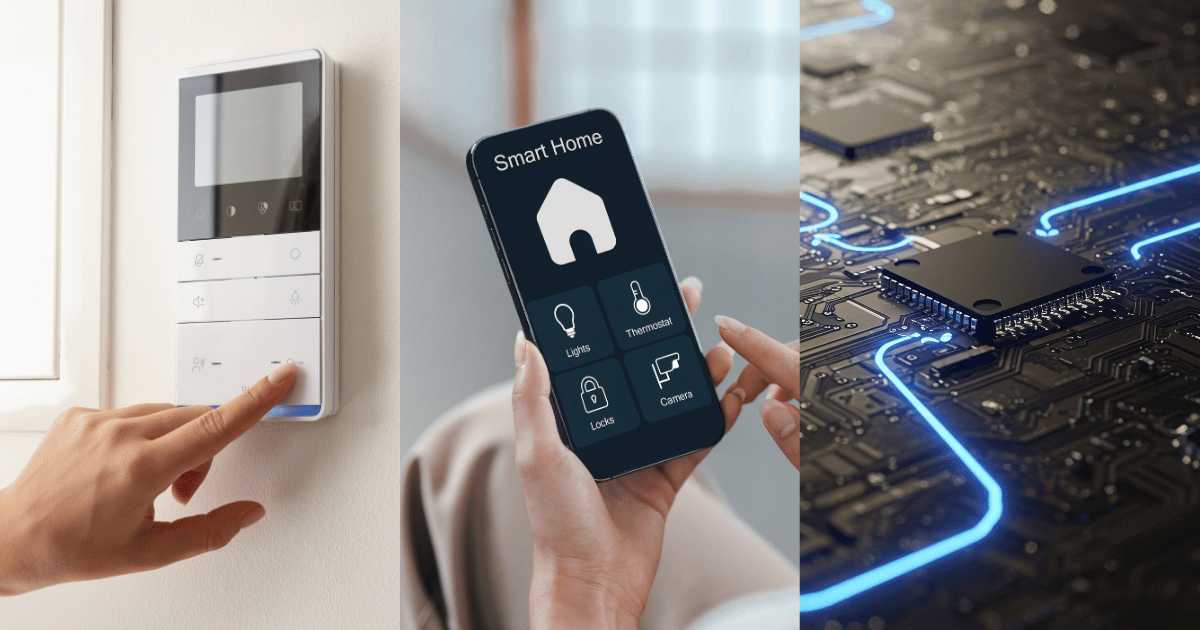
Smart controls, like popular smart thermostats or connected sensors, build on automation by adding connectivity and sensor input. These systems can collect data, communicate with cloud platforms, and respond to a broader set of conditions in real time.
Example:
WiFi thermostats controlled through a mobile app
Occupancy-based temperature setbacks
Remote monitoring dashboards that report system status
Smart controls are more responsive than basic automation, but they still rely on predefined rules and thresholds. They react to inputs as they occur, but they don’t independently improve performance over time.
Artificial Intelligence
Artificial intelligence goes a step further by using machine learning models to analyze patterns, make predictions, and optimize system behavior dynamically.
Example:
Forecasting cooling or heating demand based on historical usage and weather data
Detecting performance anomalies before a failure occurs
Adjusting equipment runtime across multiple zones to reduce energy waste while maintaining comfort
Instead of simply reacting to conditions, AI-driven systems learn how a building behaves. Over time, they refine their decisions continuously while balancing comfort, energy efficiency, and equipment wear without relying on fixed schedules.
Why This Distinction Matters
Many systems marketed as “AI-powered” are actually a combination of automation and sensors. While those features still offer benefits, they don’t deliver the same level of optimization as true AI-driven systems.
Real AI typically appears when an HVAC system can:
Predict future conditions instead of reacting to past ones
Identify inefficiencies without predefined thresholds
Continuously adjust operation to balance comfort, energy use, and equipment wear
Understanding this difference makes it much easier to evaluate claims, compare technologies, and determine whether AI is adding real value, or just a new label.
How AI Is Used in HVAC Systems Today
Instead, it is applied in specific areas where analyzing large amounts of data and adapting to changing conditions can meaningfully improve system performance.
In practice, AI-driven HVAC systems focus on reducing energy waste, improving reliability, and maintaining comfort more efficiently than traditional control strategies.
The most common and proven applications of AI in HVAC today fall into a few key categories.
Energy Optimization and Runtime Reduction
Energy optimization is the most common application of AI in HVAC systems. Instead of relying on fixed schedules or static temperature setpoints, AI analyzes real-time sensor data alongside historical usage, occupancy patterns, and weather conditions.
This allows the system to deliver only the heating or cooling that’s actually needed at a given moment, reducing unnecessary runtime and energy waste while maintaining comfort.
Common applications include:
Adjust cooling based on predicted demand rather than preset schedules
Scale back operation during low-occupancy periods
Optimizing system performance during peak energy-use periods
Predictive Maintenance
Traditional HVAC maintenance is usually time-based or reactive. AI enables a shift toward predictive maintenance by continuously monitoring system performance and identifying early warning signs of potential issues.
By analyzing trends in temperature, airflow, power consumption, and runtime, AI can flag developing problems before they lead to breakdowns or downtime.
This approach helps:
Catch declining efficiency in components like motors or compressors
Detect abnormal cycling or airflow restrictions
Reduce emergency service calls and extend equipment life
Fault Detection and Diagnostic Support
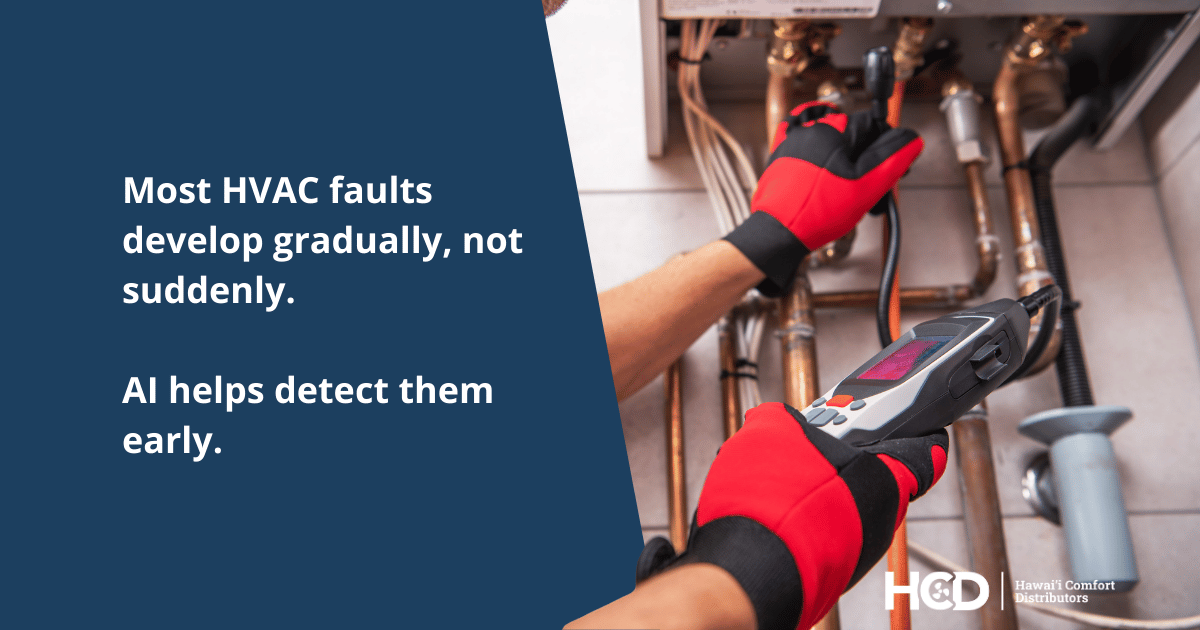
Troubleshooting HVAC systems can be time-consuming because different problems often produce similar symptoms. AI-assisted diagnostics help by analyzing multiple data points at once and narrowing down likely causes.
These tools don’t replace technicians. Instead, they provide focused insights that reduce guesswork and speed up decision making, transforming the technician’s role from reactive troubleshooting to proactive system optimization.
For HVAC professionals, this means faster site visits, clearer diagnostics, and greater confidence when supporting or commissioning modern systems, including smart thermostat installation and advanced control upgrades.
HVAC Zoning and Comfort Optimization
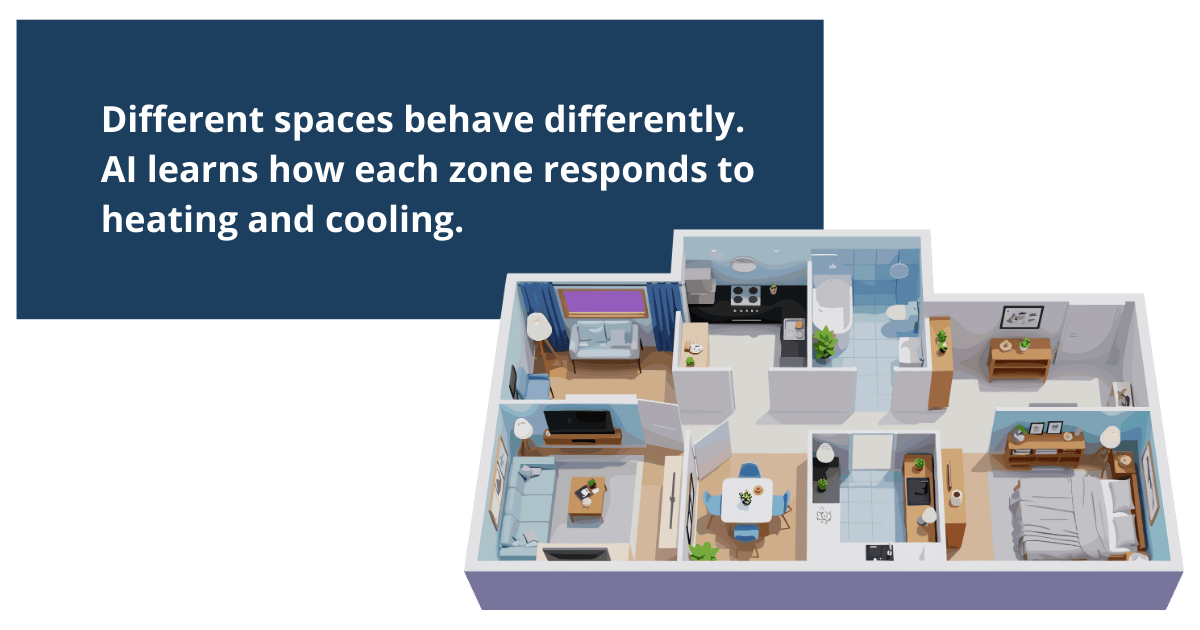
AI is especially effective in HVAC zoning systems, where different areas of a building have different usage patterns and comfort needs. Over time, AI learns how each zone responds to heating and cooling and adjusts airflow and capacity accordingly.
This results in more balanced comfort across spaces without overconditioning individual areas.
Indoor Air Quality and Ventilation Control
AI is increasingly used to manage indoor air quality by responding to real-time sensor data instead of fixed ventilation rates. Systems can adjust airflow based on CO₂ levels, humidity, and particulate readings.
This allows buildings to maintain healthier indoor air while avoiding unnecessary energy consumption.
Typical uses include increasing ventilation during higher occupancy and balancing fresh air intake with efficiency goals.
Where AI Delivers the Most Value
AI provides the greatest benefits in environments where conditions change frequently, such as buildings with varying occupancy, multiple zones, or continuous cooling demands. In these situations, the ability to predict, adapt, and optimize in real time offers clear advantages over static control strategies.
Understanding where AI is applied (and where it is not) helps set realistic expectations and ensures the technology is used where it can deliver measurable improvements.
Real-World Results: What AI-Driven HVAC Systems Are Achieving
Real-world deployments show that AI-driven HVAC systems can deliver measurable improvements in energy efficiency, system reliability, and comfort—particularly in commercial and multi-zone environments.
Energy Optimization and Runtime Reduction
Case studies and industry reports on AI-based HVAC optimization in office and mixed-use buildings have documented double-digit reductions in energy use.
A well-known commercial office retrofit highlighted by BrainBox AI showed an HVAC electricity reduction of approximately 15.8%, while broader mixed-use building pilots summarized by eeDesignIt and C3 AI deployments report 25–29% energy savings through predictive control that reduces unnecessary runtime without compromising comfort.
Predictive Maintenance and Early Fault Detection
AI-based predictive maintenance platforms analyzed in a SpringCT case study demonstrated fault prediction accuracy of up to 95% by evaluating historical HVAC sensor data.
This approach enables maintenance teams to identify developing issues weeks in advance, supporting a shift from reactive repairs to proactive maintenance and improved system uptime.
Zoning and Comfort Optimization
In multi-zone commercial environments, AI-assisted HVAC optimization has delivered energy reductions approaching 20–30%, while also improving temperature stability and comfort compliance.
Modeled results from Verdigris Technologies’ commercial building simulations show that predictive, occupancy-aware control can significantly outperform static scheduling—especially in buildings with variable occupancy such as offices, retail spaces, and mixed-use facilities.
Conclusion
AI in HVAC is most effective when it’s focused, purpose-built, and applied where it matters most. Rather than relying on fixed setpoints or constant runtime, modern AI-driven systems use predictive models to adjust performance in real time, reducing unnecessary energy use while maintaining consistent comfort.
This shift toward intelligent, data driven control is redefining what efficiency looks like in modern HVAC systems. For HVAC professionals and building decision makers alike, adopting AI driven strategies is not just about improving performance today. It is about future proofing systems, maintaining energy efficiency at scale, and staying competitive as smart building technologies continue to evolve.